
Date: 2026-08-10 Visitcount: 10
From 22 to 30 July 2026, the UNESCO Chair in Entrepreneurial Education at Zhejiang University, in collaboration with the Ministry of Higher Education, Science and Research of Mauritius, the University of Mauritius, the Open University of Mauritius, and the Mauritius Institute of Education, co-organized the International Symposium on Higher Educational Leadership, Innovation and Capacity Development in Mauritius.
The event brought together more than 230 representatives from over 40 countries and regions, including government agencies, higher education institutions, research organizations, industry partners, and international organizations. Participants engaged in in-depth discussions on key themes such as entrepreneurship education, capacity development, and artificial intelligence.
Professor Xiaozhou Xu, UNESCO Chairholder in Entrepreneurial Education at Zhejiang University, attended the symposium alongside coordinators Yue Kan, Professor Weihui Mei, and Associate Professor Shanyun He. The delegation delivered keynote speeches and held high-level consultations with distinguished participants, including Honourable Kavirej Sharma Sukon, Minister of Higher Education, Science and Research of Mauritius, and Professor Kavi Kumar Khedo, Vice-Chancellor of the University of Mauritius. These exchanges led to preliminary agreements on future collaboration in the fields of entrepreneurship education and artificial intelligence.
At the opening ceremony on 28 July, Professor Xu Xiaozhou addressed the participants on behalf of the co-organizers, extending a warm welcome and calling for the promotion of entrepreneurial spirit to advance academic entrepreneurship in a globalized era. Following the ceremony, he chaired a roundtable on entrepreneurship education. In his concluding remarks, Professor Xu highlighted the importance of reforms in entrepreneurial curricula, socio-cultural contexts, and innovation ecosystems, emphasizing that global entrepreneurship education must align with evolving educational philosophies, contemporary dynamics, and institutional innovation.
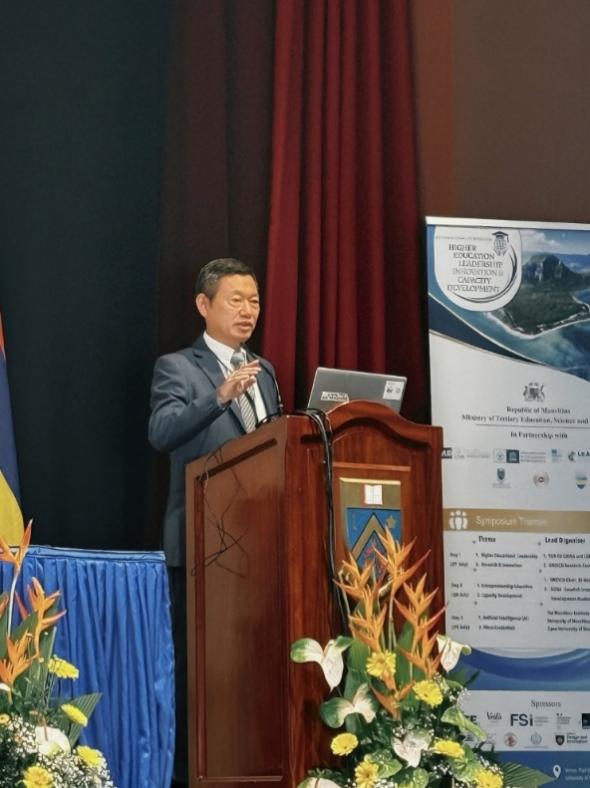
On the afternoon of 28 July, Professor Xu delivered a keynote speech entitled “Humanism or AI-lism: Challenges and Choices of Entrepreneurship Education.” He underscored the dual nature of technological advancement, noting that while innovation drives progress, it may also bring unintended consequences. In the context of artificial intelligence, he warned of emerging challenges, including potential disruptions to employment. Professor Xu stressed that entrepreneurship education in the AI era must avoid ethical pitfalls, reaffirm humanistic values, and foster a balanced integration between human intelligence and artificial intelligence to promote high-quality global development.
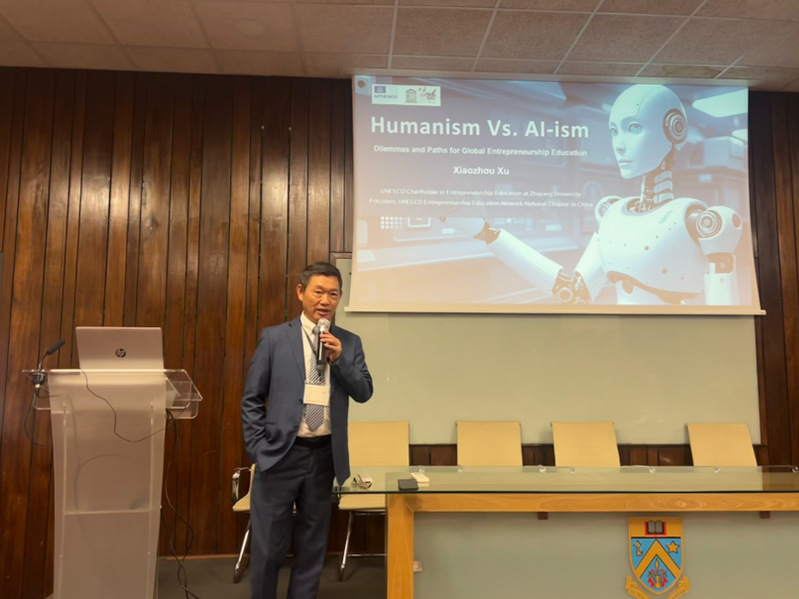
Professor Xiaozhou Xu delivers a keynote speech
Professor Weihui Mei and Associate Professor Shanyun He also delivered keynote presentations. In her talk, “Empowering the Next Generation of Entrepreneurs through China–Africa Entrepreneurship Education Cooperation,” Professor Mei proposed building a multi-level and broad-based collaborative network through joint curriculum development, shared practice platforms, and reciprocal faculty training initiatives.
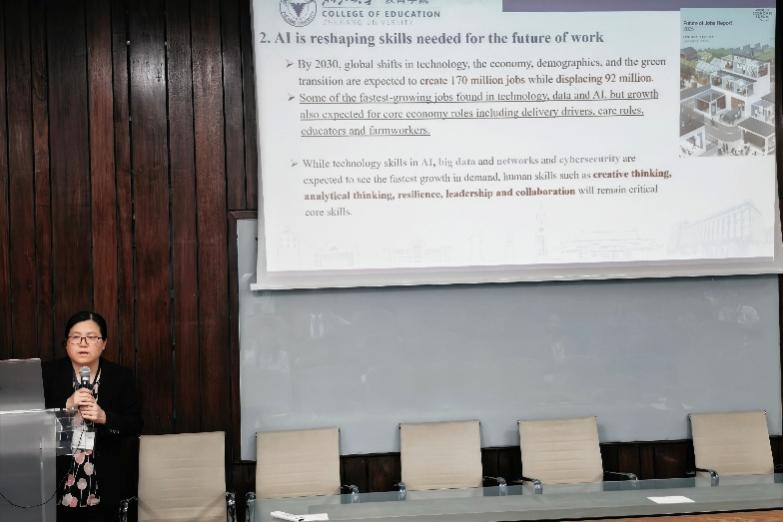
Professor Weihui Mei delivers a keynote speech
In her presentation titled “Application Scenarios, Differences, and Institutional Implications,” Associate Professor He Shanyun examined the use of generative artificial intelligence in higher education teaching. She analyzed its application scenarios, differentiated impacts, and institutional implications, and proposed forward-looking pathways for teaching reform in universities.
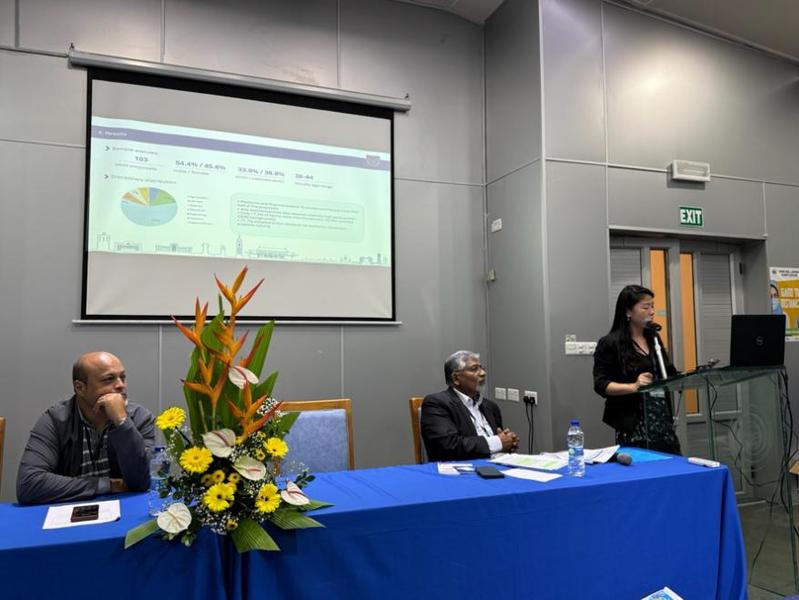
Associate Professor Shanyun He delivers a keynote speech

 College of Education, Zhejiang University
 Tel : +86 571 88273934
 Fax : +86 571 88273187